
What a Market Stall Taught Me About Masculinity
I went to Soul Sante expecting to sell pickles. Instead, I found a version of masculinity that had nothing to do with dominance or income. Standing in front of the stall, absorbing rejection and generating attention, I discovered that clean usefulness feels better than status ever did.
Posted by

Related reading
Small Businesses Must Earn the Sale
Buying local should not require guilt or extra administrative work. Independent businesses thrive when distinctive products are paired with convenience, reliability and genuine customer value.
A vegan market forced Good Gut Hut to confront what matters on first contact: taste, clarity, and a simple pitch. The weekend didn’t make the brand bigger—it made it real.
Soul Sante and the Unromantic Truth of Founding
A market stall day became a lesson in founder reality: when plans fail, you do the work; when you sell face-to-face, you get clean truth; and when you build, you lean on a village. Humility and connectedness aren’t soft values—they’re operational foundations.
Soul Sante: the day I stopped thinking sales was demeaning
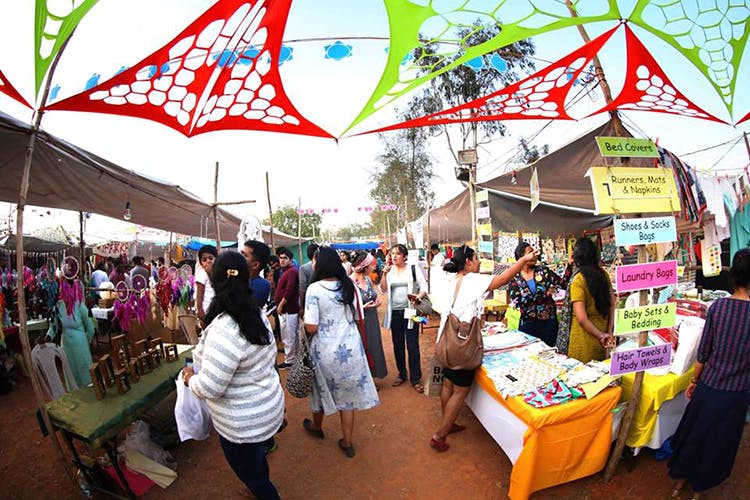 I went to Soul Sante thinking we were going to “sell pickles.”
What actually happened was closer to a business experiment + a psychological experiment conducted in public, under heat, under time pressure, under mild chaos, with a borrowed car and a driver hauling crates like we were moving house.
And somehow, I didn’t melt down.
The first punch: stall placement and the physics of “small business”
My very first thought when I saw where our stall was: disappointment.
Not because it was ugly. Because it was hard. It was physically annoying to get inventory there. During the day we did some jugaad—lifted the boundary skirt and slipped in to place cartons. We had help. I borrowed my mother’s car, we hired a driver for the whole day, and the driver was genuinely kind and hands-on, moving heavy crates from the car to the stall.
We somehow placed cartons by around 9.
Then the real challenge started: setting up the stall.
We were amateurs. Like, aggressively amateur.
The kind of amateur where you think “we printed the things, so we’re prepared,” and then reality laughs at you.
Death by a thousand tiny fuck-ups
Here’s what “not experienced at setting up a stall” looks like in real life:
- The social media poster (one big sticker with QR codes) immediately stuck to itself the moment I unwrapped it. It became a wrinkly mess before it ever touched a wall.
- Even after saving it, we couldn’t find a surface to stick it on. Eventually we found a piece of cardboard larger than the poster, slapped it on there, and it looked… terrible.
- We forgot scissors. Had to borrow scissors from a neighboring stall like helpless children.
- Our giant sunboard (A0/A1-ish) was too tall relative to the table. If I put it in front, it dwarfed everything. If I tried putting it in the back, the fridge blocked it. The stall wasn’t tall enough. It was comical.
Meanwhile, the crowd was thin for most of the day. According to the guy next to us, the layout was bad—people were diverting to another part of the event and not coming down our side.
So we had: chaos + low footfall + newbie mistakes + the background fear of “what if nothing sells?”
And weirdly, I wasn’t angry.
No resentment. Just “newbie realism”
I’m used to my brain trying to turn early friction into a personal insult.
This time, the dominant emotion was: this is what every founder goes through. Lulls, disinterest, awkward setup, logistics you didn’t predict—normal. Not a sign. Not fate. Not humiliation. Just experience debt getting paid off in public.
Devika (my wife) got a little angry at moments, which is understandable. But we regulated and kept going. No snapping. No blame. No “why are we like this?”
And then, when a sale finally happened, it wasn’t relief.
It was adrenaline, pride toward Devika, and a very specific thought: okay, replicate.
Not “yay someone bought.” More like: “What lever did we pull? Do it again.”
I became the lead magnet (and didn’t know I had that in me)
My role settled naturally.
I stood in front of the stall and made eye contact with people walking by. I approached them and offered kanji samples and pickle samples. Once they paused and stepped in, I redirected them to Devika, and she did the detailed explaining.
That’s the whole system:
- Interrupt politely (eye contact + invitation)
- Get them to taste
- Hand off to the closer (Devika)
- Convert
And here’s the funny part: my “cold approach” training helped. That muscle—walking up to strangers, starting conversations, tolerating rejection—ported over almost perfectly.
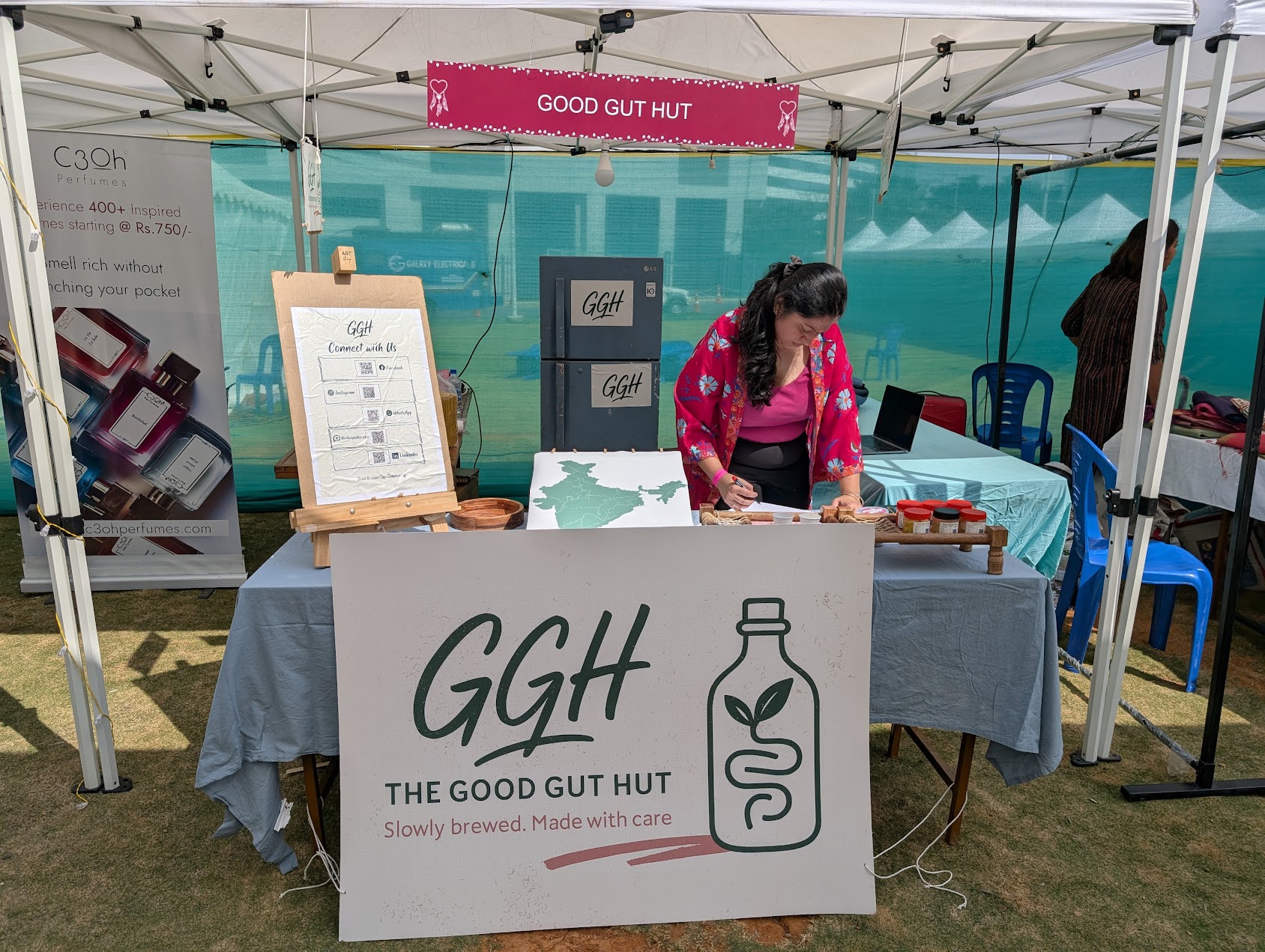 Good Gut Hut stall in Soul Sante, Bangalore
Same skill. Different arena.
Status, class, and the boomer “sabziwala” vibe
Most people were polite even when they said no—up to folks in their 50s, they’d respond like normal humans.
But older boomers and senior citizens had a specific energy. Not hostile, just curt. Head-waving dismissal. The kind of response that says, you are a vendor and I am not required to treat you like a person with feelings.
They treated me like a subziwala.
And the interesting part: it didn’t sting. Not even 2%.
In my cold-approach era, rejection could hit ego. Here, rejection was just traffic flow. Next person. Keep moving.
That alone feels like psychological progress I didn’t plan for.
Sales as a modern warrior ritual
At some point, I felt something I didn’t expect: power.
Not “I’m better than people.” More like: competence is intoxicating when it’s embodied.
It hit me that sales is the modern warrior thing you can do in the 21st century. Ancient warriors went out, fought, came back with loot. Modern businesspeople step into the market and come back with resources.
That was the vibe in my body: activated, sharp, alive.
And the ownership energy was clear too: Devika felt like the queen, and I was fighting for her. Strategic, masculine, fun—like a game. Not heavy. Not resentful. Not “provider burden.” Just: execute.
Underneath that, the deepest layer wasn’t money or status.
It was autonomy.
The feeling that there’s something I can do with my own skill that generates resources—and if I can replicate that, over and over, it’s a kind of heaven.
We didn’t “sell pickles.” We sold pre-orders (and my Google Form died)
Here’s another twist: we didn’t even sell a ton of inventory on the spot.
We mostly sold pre-orders for kanji after giving free samples.
We took names, locations, phone numbers, quantities.
The plan was to do it cleanly with a Google Form.
Reality said: no.
- I couldn’t find the URL quickly.
- Opening forms.google.com took me to the editing version.
- Preview mode wasn’t capturing responses properly.
- My internet became unreliable.
- It got dark.
- My phone overheated from being in the sun and started acting weird.
So the entire “digital system” failed right when it mattered.
And what saved the funnel?
A notebook and a sketch pen. Not even a regular pen—because we forgot pens too.
Devika pushed hard for analog. I resisted (ego). I’d spent time setting up the form and I wanted the system to be used. We had a small fight, then I said “fuck it” and adapted.
We took one order per page.
It felt super primitive. But it worked. In that moment, I admired the flexibility more than the plan. The form didn’t become useless—it’ll still help us tally later—but the day was a reminder that “clean workflows” are fragile, and scrappy workflows are anti-fragile.
The exit was brutal. The ending was euphoric.
Entering was easier because of the boundary-skirt jugaad.
Exiting? Strictly not allowed.
We had to walk everything out to the gate. The only redeeming feature was that the organizers provided trolleys. We did two full trips: loaded trolley, huge zigzag walk, unload, go back, repeat. Then security wouldn’t let the driver come close enough, so loading the car became another mini-battle.
It was a lot.
And when I finally sat in the car, the dominant feeling wasn’t exhaustion.
It was exhilaration. Happiness. Pride. Accomplishment.
We made sales. Not enough to cover even half of what we spent on the event. But I still wanted to do it again—because I’m optimistic about what it creates: visibility, repetition, people seeing we exist, a growing surface area for future transactions.
The ROI wasn’t purely financial. It was psychological and strategic.
The biggest win: I didn’t get overstimulated
We were there for around 13 hours (got there around 9, wrapped around 10).
Noise, heat, social interaction, physical labor, unpredictability—the exact conditions where my system can get saturated. Historically, that’s where I become moody, resentful, or crash.
It didn’t happen.
No meltdown. No anger. No resentment.
I’m not claiming some magical transformation, but I do think one thing helped: I deliberately did Shambhavi Mahamudra that morning, knowing it’s a tool that gives me energy and regulation for long days. I felt less hunger, less agitation, less bathroom urgency—just steadier capacity.
I ended the day calm and supercharged. That combination is rare for me.
Conclusion
Soul Sante taught me that sales doesn’t have to feel like humiliation. When it’s rooted in ownership, belief, and real human interaction, it can feel exhilarating—like a clean, modern form of combat. We showed up as amateurs, made a dozen small mistakes, watched our “proper” systems fail, and still found a way to create demand with a notebook and a sketch pen. The most surprising outcome wasn’t the revenue—it was discovering a version of myself that can stay regulated, adapt fast, and enjoy the arena.