
Why Threats Against Judges Cluster Around Power Disputes
Judges aren’t threatened in proportion to a ruling’s moral horror, but to the losing side’s organized, identity-bound capacity to coerce. The antidote is conduct-based enforcement and post-harm incentive forensics—not category-based repression.
Posted by

Related reading
The Rentier State Behind Authoritarianism
Authoritarianism is often blamed on religion when the deeper cause is political economy. States financed by oil, foreign patrons, or illicit markets can survive without taxation—and therefore without accountability to their citizens.
Stop Selling Reservation as Welfare: It’s Representation
The reservation debate stays stuck because it’s framed as compensation, poverty relief, or a temporary ladder. A representation-and-reach framing treats it instead as institutional design: building a state that serves every stakeholder it governs.
When Does Wealth Become Sovereign?
Modern states justify taxation and regulation as fairness and stability. But beneath the moral language lies an older structural problem: preventing private actors from becoming sovereign in practice. From castles to capital, the tools changed. The anxiety didn’t.
Why Some Judgments Trigger Threats (and Others Don’t)
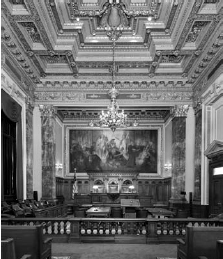
Image credit: Wikimedia Commons

The asymmetry feels obscene.
A judge can deliver a judgment that effectively lets a rapist or murderer walk, and the worst consequence might be a week of outrage and a few angry panels on TV. But let a judge touch a dispute involving succession, religious legitimacy, or institutional control, and suddenly the threats arrive—sometimes against the judge’s family, sometimes coordinated, sometimes relentless.
It’s not proportional to moral seriousness. It’s proportional to organized grievance.
Judges usually don’t get threatened because a judgment is morally horrible. They get threatened when a judgment hurts a group that is organized, identity-bound, emotionally invested, and capable of mobilizing pressure.
A rape/murder acquittal may outrage the public, but that outrage is diffuse. People are angry, then life moves on. There usually isn’t one tight-knit, high-control community with money, hierarchy, networks, and a single focused demand: “Undo this outcome or else.”
In cases like Gautam Patel’s, the issue isn’t just “wrong judgment” to some people. It’s succession, legitimacy, institutional power, property, and identity. That kind of dispute produces fanatics because the judgment doesn’t merely say “X won”; it appears to validate one side’s entire claim to authority. For the losing side—or the extremists orbiting it—the judge becomes a symbolic enemy.
That’s the difference between:
- “This judge is incompetent / corrupt / insensitive.”
- “This judge attacked our truth, our leader, our community.”
The second sentence is how you get threats.
The Logic of Intimidation: It Picks the Easiest Target
There’s another grim reason intimidation clusters around certain kinds of cases: personalization.
When awful criminal judgments happen, the system’s fog protects everyone. Evidentiary gaps. Hostile witnesses. Bad investigations. Procedural defects. “Benefit of doubt.” The judge can always say, “I followed the record.” Even when the public suspects nonsense, there isn’t always one clean, personal target for the anger.
But in a succession or legitimacy dispute, the outcome is crisp and symbolic. The judge’s name gets fused to a single headline: “He gave legitimacy to that side.” That’s easy to personalize, easy to mythologize, and easy to weaponize.
And that’s exactly why threats against judges are uniquely dangerous—not because judges are saints (many judgments are terrible), but because once intimidation becomes a working appellate mechanism, the most fanatical faction gains an extra legal remedy the rest of us don’t.
“So Break Them Down” — The Temptation and the Trap
When a group starts threatening judges or their families, it stops being “hurt sentiment” and becomes an attack on the justice system itself. The impulse is natural: use intelligence agencies, target these networks, break them down.
But the state response has to be surgical and legal, not vague “crush the group” power. Otherwise the cure becomes worse than the disease.
A sane state can do all of the following without drifting into political policing:
-
Treat threats to judges as national-security-adjacent
Not because judges are aristocrats, but because intimidation of courts is an attack on state capacity. -
Use intelligence to map the network
Who issued threats? Who coordinated? Who funded? Who provided ideological cover? Who amplified? -
Separate extremists from the broader community
The target should be the coercive network—people threatening, financing harassment, arranging attacks—not every ordinary member of a religious or social community. -
Prosecute, freeze, expose
Arrests, charges, financial scrutiny, digital forensics, protection orders, immigration alerts, extradition requests where relevant, and public naming where legally justified.
The state should be terrifying to people who threaten judges. But it should be terrifying through procedure, not outside it.
Because the moment intelligence agencies get a blank cheque to “break groups,” they will eventually use it against dissidents, journalists, opposition, minorities, business rivals—anyone inconvenient. India already has enough arbitrary power. What it needs is accountable power.
The Antitrust Analogy (and Why It’s Both Useful and Dangerous)
There’s a strong analogy here: we regulate monopolies because the state recognizes a basic truth—private power can become dangerous even before it commits ordinary crimes.
A monopoly may not be violent, but it can distort markets, crush rivals, capture consumers, and become structurally abusive. So we don’t wait for a monopoly to “commit murder” before acting; we regulate dominance and abuse.
The social equivalent is obvious: organized groups—NGOs, unions, religious bodies, caste associations, student unions, business lobbies—can become coercive mini-states. They can intimidate, extort, enforce internal obedience, or sabotage lawful processes.
So why not regulate them the way we regulate monopolies?
Because the danger profile changes. With monopolies, the tests are messy but relatively administrative: dominance, abuse, exclusionary conduct. With “hateful groups” or “NGOs beyond scope,” the test touches speech, religion, association, dissent, protest, minority rights, political opposition. That’s where lazy governments get a vocabulary of repression:
- “Anti-national.”
- “Foreign destabilization.”
- “Hurting sentiment.”
- “Public order risk.”
- “Beyond scope.”
And suddenly environmental activists, journalists, student groups, civil-rights organizations, and minority communities become permanent suspects—because the category becomes the crime.
The right model is not “ban groups with bad ideology.” It’s closer to competition law for coercive power: target conduct, not identity.
Conduct-based red lines look like this:
- threats and harassment
- witness tampering
- judge intimidation
- extortion
- doxxing and coordinated stalking
- illegal funding channels
- incitement to violence
- “parallel courts” and enforcement systems
- organized obstruction of legal process


That’s the clean standard: regulate abuse of organized power, not mere belief.
“But These Groups Deserve to Be Watched”
It’s true that any organized power center deserves scrutiny. Civil society isn’t automatically virtuous.
Environmental groups can obstruct infrastructure. Civil-rights groups can overreach into entitlement politics. Student unions can compromise education or become party fronts. Religious groups can try to form parallel authority. Opposition-linked NGOs can run covert political operations. Business lobbies can corrupt policy and push harmful products.
The mistake is turning valid risks into category-based suspicion:
- “Environmentalists are suspect.”
- “Religious minorities are suspect.”
- “Opposition NGOs are suspect.”
That becomes regime protection, not republic protection.
A better standard is: the state watches power, not identity; it intervenes on conduct, not ideology.
You can even sketch this as a practical filter:
- Pressure alone → light monitoring
- Pressure + capability → audits and scrutiny
- Pressure + repeated harmful pattern → formal investigation
- Pressure + unlawful direction from leadership → prosecution and dismantling of the coercive arm
The point is to build triggers that don’t depend on who you are, but on what you are doing.
The Real Root: Internal Pressure is Where Malice Begins
Here’s the sharper insight: malicious institutional behavior usually begins before the crime is visible. It begins as internal incentive pressure.
Most organized wrongdoing doesn’t start with, “Let’s commit crimes.” It starts with:
- “Hit the target.”
- “Protect the leader.”
- “Don’t embarrass the organization.”
- “Win at any cost.”
That pressure converts ordinary members into instruments.
The car salesman example captures it perfectly. Selling cars is fine. Persuasion is fine. Commission is fine. But if the organization imposes impossible targets, punishes honesty, rewards deception, and looks away as fraud increases sales, unethical behavior becomes predictable. At that point the problem isn’t “bad individual salesman.” It’s bad incentive architecture.
This applies everywhere in India:
- Students cheat because marks become existential.
- Doctors overprescribe because revenue targets reward procedures.
- Cops extort because “collections” are normalized.
- Bureaucrats delay because risk of action is higher than risk of inaction.
- Political workers intimidate because aggression is rewarded.
India over-polices individuals and under-polices systems.
A Better Model: Incentive Forensics (Especially After Harm)
“Policing internal pressure” sounds like thought control, and it would be. But there’s a version of this idea that is both powerful and defensible:
Don’t preemptively monitor everyone’s internal culture. When harm happens, investigate the incentive structure that made it predictable.
Take a simple example: a restaurant railing collapses and kills a patron. The normal questions are:
- Who owns the restaurant?
- Was the railing defective?
- Was there negligence?
But the serious investigation asks:
- Why was the railing allowed to remain unsafe?
- Was repair delayed to avoid cost?
- Were inspections fake or bribed?
- Were maintenance budgets cut?
- Were complaints ignored?
- Did near-misses get covered up?
Because “the railing collapsed” isn’t the full event. The full event is a chain of incentives that made it rational for multiple people to ignore the risk until gravity enforced the law.
This should become standard across sectors: every serious harm investigation should include an incentive causation chapter. Not just “who did it,” but “who benefited from not preventing it,” “what warnings existed,” and “what internal pressures normalized noncompliance.”
Conclusion
Threats against judges aren’t a thermometer of moral outrage; they’re a meter of organized coercive capacity. If intimidation becomes an informal appeal process, the most fanatical faction gets more legal power than everyone else. The fix isn’t category-based suppression—it’s conduct-based enforcement, and after harm, ruthless incentive forensics that climbs the chain. That’s how a republic grows teeth without becoming a predator.