
A Million Little Earths, Not Mars
Mars absorbs our frontier dreams, but the practical path to a spacefaring civilization points elsewhere: modular, rotating habitats engineered for human life. They scale better than planets, make politics and conflict more local, and turn the solar system into a navigable archipelago of designed wor
Posted by

The Future Probably Isn’t Mars. It’s a Million Little Earths You Can Turn Off.
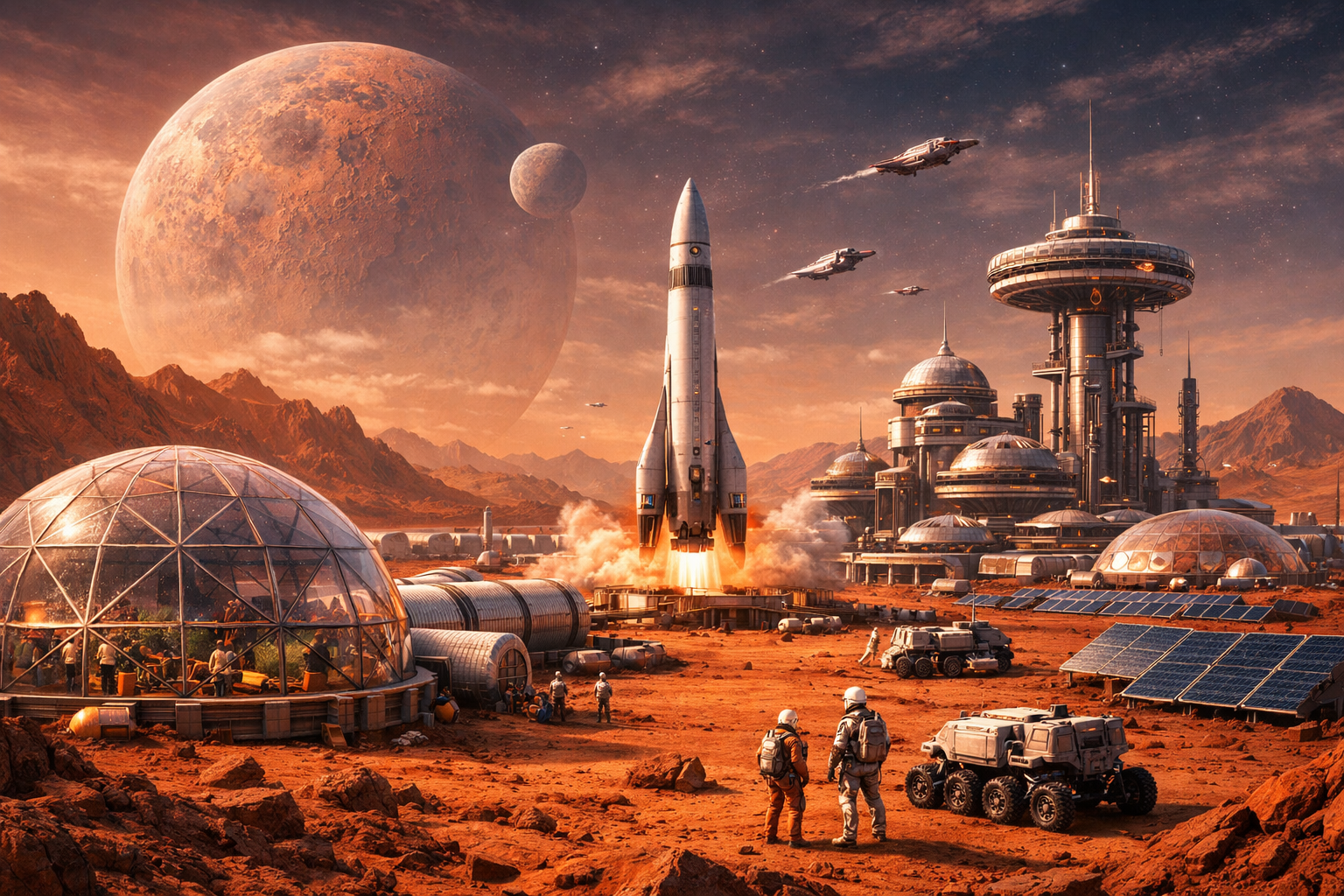 Mars is the place we keep projecting our frontier fantasies onto. It has a horizon. It has a day that’s almost a day. It’s close enough to touch. It feels like a sequel to Earth.
But if you strip the romance off and ask a colder question—where would humans actually live if we spread through the solar system?—planets start looking like the wrong substrate.
The more you follow the constraints (physics, energy, biology, economics), the more the answer keeps snapping back to the same idea:
Not terraforming. Not interstellar empires. Not “walking outside in a T‑shirt.”
Space habitats.
Artificial worlds built to spec, in places where the raw materials are cheap to move and the sunlight is abundant. Not a single shiny megacity-planet, but a swarm of rotating homes—some the size of towns, some the size of countries—each one a life-support system with a skyline.
Interstellar Travel: The Thing That Keeps Not Getting Easier
A lot of confusion comes from lumping “space” into one category. Interplanetary expansion and interstellar travel are not just different difficulties; they’re different universes of cost.
The nearest star system is over four light-years away. At today’s probe speeds, you’re looking at tens of thousands of years. Even if you daydream your way to a meaningful fraction of light speed, you’re still talking decades one-way, plus problems that don’t feel cinematic until you try to solve them: radiation, dust impacts at relativistic speeds, biology over multi-decade confinement, and the simple question of why you’re doing any of this when your own star system is basically a bottomless bank account of energy and matter.
Robotic probes? Sure. Tiny, one-way, data-return missions that ride lasers or sails are at least plausible.
A human interstellar civilization? That’s not “hard.” That’s “requires humans to stop being human,” or requires economics to stop being economics.
So if the story is “humans spread out,” it’s overwhelmingly likely they spread locally first—because local is where the payoff is.
Terraforming: Rebuilding Earth From Scratch, But Worse
Terraforming sounds like a normal engineering project because we say it in one word.
What it really means is: take an entire planet with its own history, geology, chemistry, and feedback loops, and force it into a stable Earth-like state that stays pleasant without constant heroic intervention.
Mars is the usual candidate because it’s “close” and “almost.” But “almost” is doing a lot of lying.
- The atmosphere is extremely thin.
- There’s no global magnetic field to protect and retain that atmosphere.
- It’s cold, and it swings hard.
- The gravity is low enough that long-term human health outcomes are still a big unknown.
- Even a warmed-up Mars is still a radiation problem and a pressure problem.
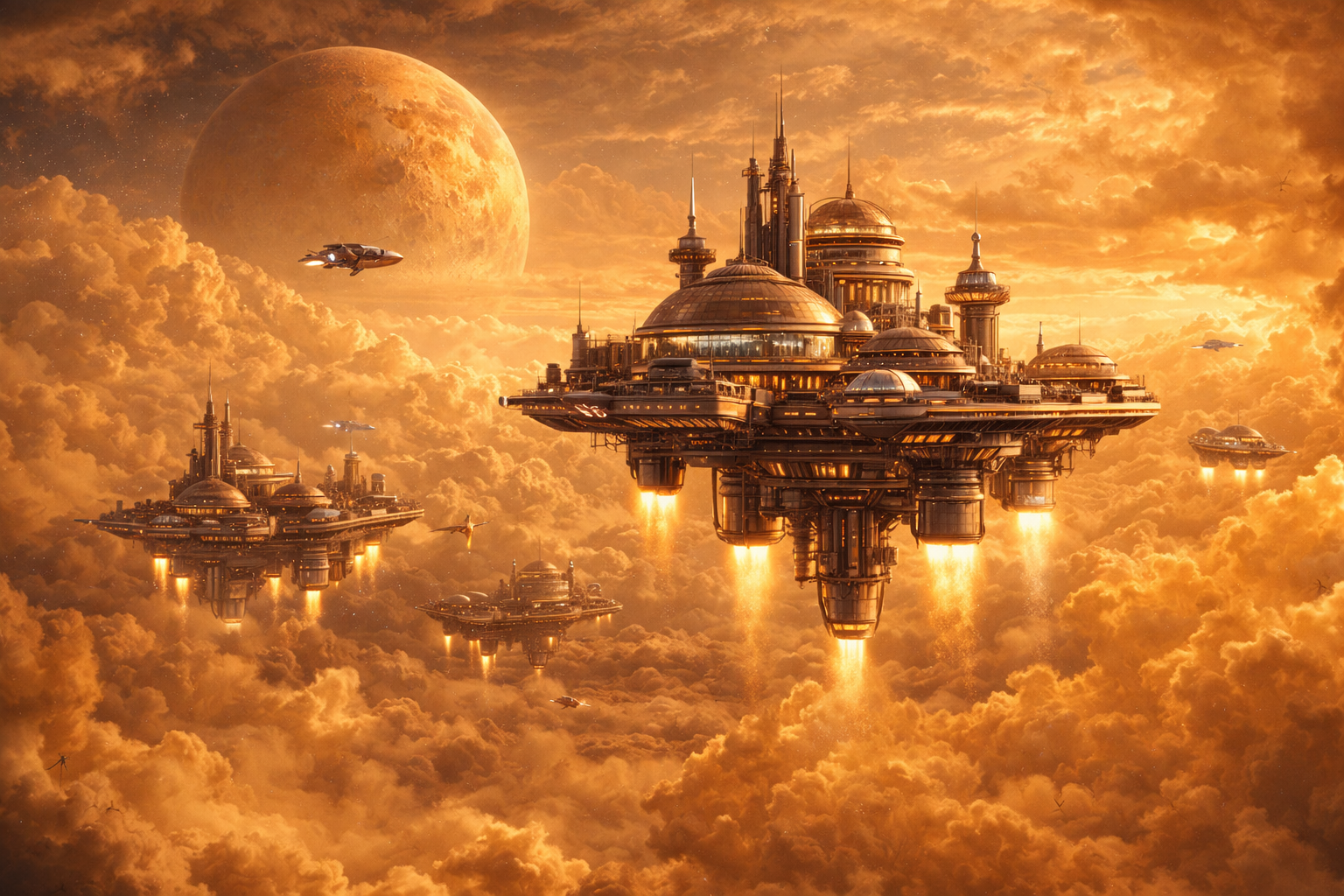
Venus is worse at the surface—an atmospheric ocean of crushing pressure and lethal heat—but it has a twist: up in the clouds, there’s a band where pressure and temperature are eerily Earthlike. Which doesn’t make Venus terraformable; it makes Venus a good argument for not needing terraforming if you’re willing to build habitats.
Titan feels cozy because it has a thick atmosphere and good radiation shielding. Then you remember it’s cryogenic, has no oxygen, and “weather” means methane.
The deeper point isn’t that terraforming is impossible in a pure physics sense. It’s that terraforming is a planetary-scale bet where the “minimum viable product” is still hostile, and the cost is so absurd that you’d only do it if you had no better options.
 But we do.
Space Habitats: Stop Fighting Planets, Start Building Environments
A space habitat is the inversion of terraforming.
Terraforming asks: how do we fix a planet that doesn’t want us?
Habitats ask: what if we just build a place that already works for us?
The core trick is rotation. Spin a structure and you can get effective gravity on the inside. Then you wrap it in shielding, fill it with air, manage temperature with radiators, and pipe in sunlight with mirrors. No exotic physics required—just industrial capacity and obsessive engineering.
There are a few canonical shapes:
- Stanford torus / Bernal sphere: smaller, easier, “first real town in space” scale.
- O’Neill cylinder: the iconic one—long rotating cylinders where the interior can look like valleys and farmland and cities under a curved sky.
- McKendree-scale cylinders: far-future, materials-limited monsters—country-sized interiors that start behaving like worlds.
The reason habitats beat planets isn’t aesthetics. It’s control.
- Gravity is tunable instead of fixed.
- Atmosphere is replaceable instead of something you pray doesn’t leak into space over eons.
- Climate is engineered instead of inherited.
- Failure is local. One habitat dies, not a whole civilization.
- You can scale by building another one, not by “changing a planet forever.”
From a systems perspective, planets are hard-coded. Habitats are modular.
“Crowded” Solar System: Not Coruscant, More Like a Glowing Archipelago
When people hear “millions of habitats,” they imagine traffic jams and a packed skyline around the Sun. That’s not what “crowded” means at astronomical scales.
Even a dense civilization would be spread across distances that make our brains misfire: millions of kilometers between neighbors is normal. The solar system is huge, and it’s three-dimensional.
Most habitats would cluster near the solar system’s “river”: the ecliptic plane, where the mass already is and where moving stuff is cheapest. Not a razor-thin disc, more like a thick pancake with bands of inclination as things mature and start caring about collision risk and “zoning.”
Could you put habitats far above or below that plane? Absolutely. It’s just inefficient, so it becomes a choice—like living in a mountain monastery instead of a coastal city.
And yes: there’s a real upper bound on how many giant habitats you can build from asteroid material alone, because shielding mass dominates. Millions of city-scale habitats? Plausible over long time horizons. Millions of extreme McKendree-scale cylinders? Probably not without dismantling major bodies. But the idea doesn’t require maximalism to work; it works even if you build “only” tens of thousands of large habitats and a vast number of smaller ones.
Travel: You Don’t Go Places, You Change Orbits Until You Meet Them
In a habitat civilization, everything is moving all the time. “Across the Sun” isn’t an obstacle; it’s a scheduling detail.
Space travel becomes less like driving and more like shipping:
- Slow, efficient routes that are cheap in energy and heavy on planning.
- Faster routes that cost more.
- Transfer windows and published trajectory calendars.
- A culture that treats travel as a journey, not a hop.
You don’t wait for two habitats to be “on the same side.” You pick a trajectory and pay with time or energy.
If you want a mental model: trains plus ocean freight, not cars.
Sovereignty: Every Habitat Is a Border You Can’t Ignore
A habitat is a city where the air is owned. That changes politics.
It’s hard not to become sovereign-ish when you control your atmosphere, your docking ports, and your life support. Entry and exit are literal. Immigration policy is a hatch and a schedule.
So yes: many habitats will behave like city-states.
But “fully independent forever” is expensive. Even stubborn polities still need shared rules for navigation, docking standards, biosecurity, trade law, and dispute resolution—because nobody wants disagreements to turn into debris fields.
The likely pattern is layers: strong local sovereignty plus federations and treaties for the boring stuff that keeps everyone alive.
War: Capture and Coerce, Don’t Shatter
Warfare in this world is shaped by a brutal constraint: destroying habitats is usually irrational.
Blowing up a habitat isn’t “winning.” It’s vaporizing an investment, murdering a workforce, collapsing supply networks, and creating a long-lived debris hazard that threatens everyone—including you. It’s the kind of act that gets categorized as terrorism or extinction-level escalation.
So conflict trends toward:
- Blockades (deny docking, deny propellant, deny trade).
- Cyber and systems warfare (attack scheduling, power routing, sensors, automation).
- Legal-economic warfare (insurance, embargoes, asset freezes, blacklists).
- Precision disablement of external infrastructure (radiators, mirrors, comms, ports) instead of mass killing.
Violence doesn’t disappear. It becomes quieter, more bureaucratic, and more focused on control than spectacle.
The Sun as the God-Object
This is where the setting stops being “small” and starts being epic.
In a habitat civilization, the Sun isn’t background lighting. It’s the central character: constant, blinding, life-giving, indifferent. Mirrors the size of cities pivot. Shadows crawl across landscapes you built. “Weather” can be a policy decision. A missed maneuver can be a tragedy written years in advance.
The scale is already there. The only thing missing is writers and designers who stop treating physics like an inconvenience.
Could a Hidden Habitat Already Exist?
Romantically: it’s a great prompt.
Physically: it runs into thermodynamics.
Anything inhabited and active has to dump waste heat. No stealth field fixes that. If something is using meaningful energy, it glows in infrared. It also has mass, and mass perturbs orbits. A large, inhabited megastructure in our solar system would be difficult to hide for long.
A dead, cold relic is the only edge case that’s even vaguely plausible: powered down, near background temperature, not doing much. But that’s not a secret civilization—it’s an artifact. And it’s still an extraordinary claim that would need extraordinary evidence.
Conclusion
If humans build a long-lived spacefaring civilization, it probably won’t be a handful of struggling outposts on hostile planets. It’ll be a distributed ecology of engineered worlds—habitats that are smaller than planets but vastly more livable, scalable, and controllable. Mars can be useful without being the destination. The real “new worlds” are the ones we can design, repair, and multiply.